

LM25
Aluminium Casting Alloy LM25
MRT manufactures gravity die castings, sand castings and high pressure die castings in LM25 Aluminium Alloy.
One of the greatest benefits of selecting LM25 is the strength that can be achieved in the heat treated condition but heat treatment cannot normally be used on high pressure die castings, meaning that LM25 is most commonly used for gravity or sand casting.
This alloy conforms to BS 1490:1988 LM25. Castings are standardised in the cast (M) condition, the precipitation treated (TE) condition, the solution treated and stabilised (TB7) condition and the fully heat treated (TF) condition.

Chemical Composition
| % | % | % | |||
|---|---|---|---|---|---|
| Copper | 0.20 max | Magnesium | 0.20-0.6 | Silicon | 6.5-7.50 |
| Iron | 0.5 | Manganese | 0.3 max | Nickel | 0.1 max |
| Zinc | 0.1 max | Lead | 0.1 max | Tin | 0.05 max |
| Titanium | 0.2 max | Aluminium | Remainder | Others each | 0.05 max |
| Others total | 0.15 max |
Mechanical Properties
|
|
LM25-M |
LM25-TE |
LM25-TB7 |
LM25-TF |
||||
|
|
Sand |
Gravity |
Sand |
Gravity |
Sand |
Gravity |
Sand |
Gravity |
|
0.2% Proof Stress (N/mm2) |
80-100 |
80-100 |
120-150 |
130-200 |
80-110 |
90-110 |
200-250 |
220-260 |
|
Tensile Strength (N/mm2) |
130-150 |
160-200 |
150-180 |
190-250 |
160 |
230 |
230-280 |
280-320 |
|
Elongation (%) |
2 |
3 |
1 |
2 |
2.5 |
5 |
- |
2 |
|
Impact resistance Izod (Nm) |
- |
- |
- |
- |
- |
- |
- |
- |
|
Brinell Hardness |
55-65 |
55-65 |
70-75 |
75-95 |
65-75 |
65-75 |
90-110 |
90-110 |
|
Modulus of Elasticity (x103 N/mm2) |
71 |
71 |
71 |
71 |
71 |
71 |
71 |
71 |
|
Shear Strength (N/mm2) |
- |
- |
140 |
- |
- |
- |
180 |
250 |
Strength at elevated temperatures
The tensile properties of LM25 alloy at elevated temperatures are influenced by the condition (heat treatment) of the castings and the duration at the elevated temperature.
On short term testing e.g. 30 minutes at temperature, the properties fall only slowly and uniformly up to about 200 deg C, at which temperature the strength of LM25-TF is reduced by about 20%.
Very prolonged heating, e.g. 10,000 hours, results in a sharp loss of strength at about 135 deg c. At 200 deg C the strength of LM25-TF is less than half of that at room temperature. There is therefore no advantage to be gained by heat treatment, if the component is to be used at temperatures above about 130 deg C, for extended periods of time.
Physical Properties
|
|
|
|
Coefficient of Thermal Expansion (per °C @ 20-100°C) |
0.000022 |
|
Thermal conductivity (cal/cm2/cm/°C @ 25°C) |
0.36 |
|
Electrical conductivity (% copper standard @ 20°C) |
39 |
|
Density (g/cm3) |
2.68 |
|
Freezing range (°C) approx. |
615-550 |
Machinability of LM25
The heat-treated alloy has fairly good machining properties, but tools should preferably be of high speed steel and must be kept sharp. A moderately high rate of tool wear may be expected. Liberal cutting lubricant should be employed. Find out more about MRT’s machining resources.
Corrosion Resistance
As with LM6, resistance to corrosive attack by sea water and marine atmospheres is high with this alloy.
Anodising
A protective anodic film can be obtained by either the sulphuric or chromic acid process, but the grey opaque character of coatings of normal thickness precludes their colouring in light shades for decorative purposes. Find out more about the other surface finishes offered by MRT.
Heat Treatment
There are three common heat treated conditions for LM25:TE (precipitation treated), TB7 (solution treated and stabilised, and TF (fully heat treated). Read the full description of our heat treatment processes.
Applications and General notes
LM25 is mainly used where good mechanical properties are required in castings of shape or dimensions requiring an alloy of excellent castability in order to achieve the desired standard of soundness.
The alloy is also used where resistance to corrosion is an important consideration, particularly where high strength is also required. It has good weldability.
Consequently, LM25 finds application in the food, chemical, marine, electrical and many other industries and, above all, in road transport vehicles where it is used for wheels, cylinder blocks and heads, and other engine and body castings. Its potential uses are increased by its availability in four conditions of heat treatment in both sand and gravity die castings.
It is, in practice, the general purpose high strength casting alloy, whose range of uses is increased by its availability in the as-cast and partially heat-treated condition as well. It is used in nuclear energy installations and for aircraft pump parts. LM25 may be superior for castings, particularly in gravity dies, which are difficult to make to the required standard of soundness. It offers better machinability and mechanical properties than LM6.
HOW can MRT Castings help you?
I want...
- Select what you need
- a complete solution
- to develop a new component from initial concept
- advice on what processes are best suited to my component
- prototypes before committing to production tooling
- to re-shore production to the UK from overseas
- a new supplier to use existing tooling
- to convert a machined from solid part to a casting
- a supplier who can meet stringent quality requirements
New at MRT Blogs

Visit us at stand C240 on the 6th, 7th & 8th of February 2024.
Read MoreMRT Secure Cyber Essential Plus Standard
17th Jul 2023

MRT Castings is proud to announce that it has achieved certification to the ‘Cyber Essentials Plus’ standard.
Read MoreMRT Castings Wins Queen's Award
21st Apr 2022
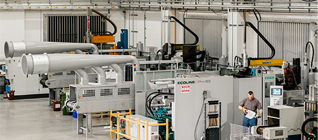
Leading UK aluminium die casting foundry, MRT Castings Ltd, have been honoured with a Queen’s Award for Enterprise.
Read More